A Name, A Right, A Movement - Adding mother's name in the child 's name
At Espalier Heritage School, education is not limited to textbooks—it is a pathway to creating meaningful social change. Nearly a decade ago, our students embarked on a journey that would challenge deep-rooted societal norms and spark a powerful movement for gender equality.
It began with a simple yet profound question posed to our Grade 8 students:
Why does gender inequality still persist, and what can we do to change it?
As students explored this question, they uncovered the realities faced by women, particularly in rural India. Despite legal protections, inequalities continue to exist. Girls often face lower school retention due to early marriage and household responsibilities. Women contribute immensely to agriculture and domestic work, yet their efforts are rarely recognized. Decision-making in families and communities often remains male-dominated, and access to healthcare, mobility, and opportunities is limited.
Amid this exploration, students noticed something subtle yet deeply symbolic—identity itself reflected inequality.
In Maharashtra, as in many parts of India, official naming conventions traditionally required the father’s name as part of a child’s full name, while the mother’s name was not mandatory. From school records to official documents, the mother’s identity was often absent.
This realization sparked a powerful idea.
Using design thinking, students identified this as a systemic issue embedded in everyday practices. Their solution was simple, yet transformative:
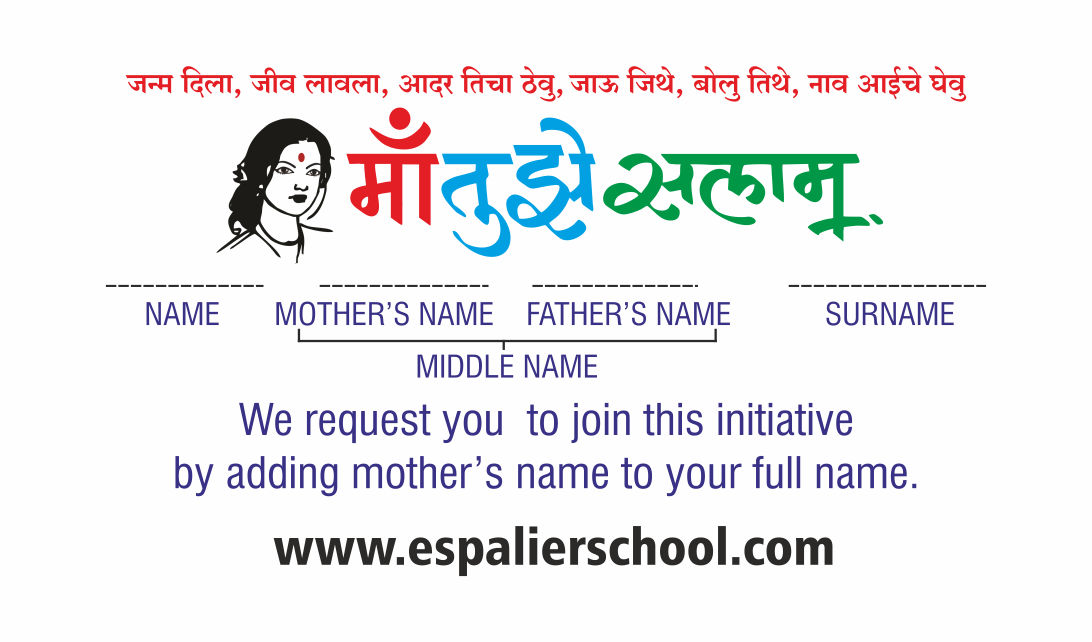
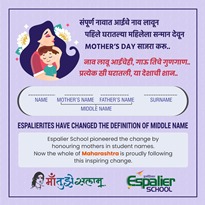
Include the mother’s name alongside the father’s name in all official records.
The school immediately supported this student-led initiative. Over 800 students adopted the change, and Espalier revised all its documentation—admission forms, ID cards, progress reports, and school records—to reflect both parents’ identities equally.
What started within the school soon extended beyond it.
Younger students carried the message into their neighbourhoods, encouraging families to adopt the practice. Senior students took the initiative further by visiting other schools, interacting with principals, and conducting awareness sessions. The movement gained momentum through consistent advocacy and community engagement.
Every year, on Women’s Equality Day (26th August), Espalier leads campaigns to promote gender respect and equal identity recognition, reinforcing the importance of acknowledging both parents equally.
Over time, this student-driven initiative evolved into a broader social movement. Thousands of families and multiple schools across Maharashtra began adopting the practice. The collective effort of students, educators, parents, and community members created a ripple effect that reached policymakers.
In a significant milestone, from 2025 onward, Maharashtra officially recognized the inclusion of the mother’s name in a child’s full name.
What began as a classroom discussion transformed into a state-level reform, proving the power of young minds when guided with purpose and empathy.
This initiative is not just about adding a name—it is about restoring identity, dignity, and equality.
It stands as a testament to Espalier’s belief that education must empower students to question, to act, and to lead change. Because sometimes, the smallest change—like adding a name—can redefine how society sees equality.
And at Espalier, that change begins with our students.